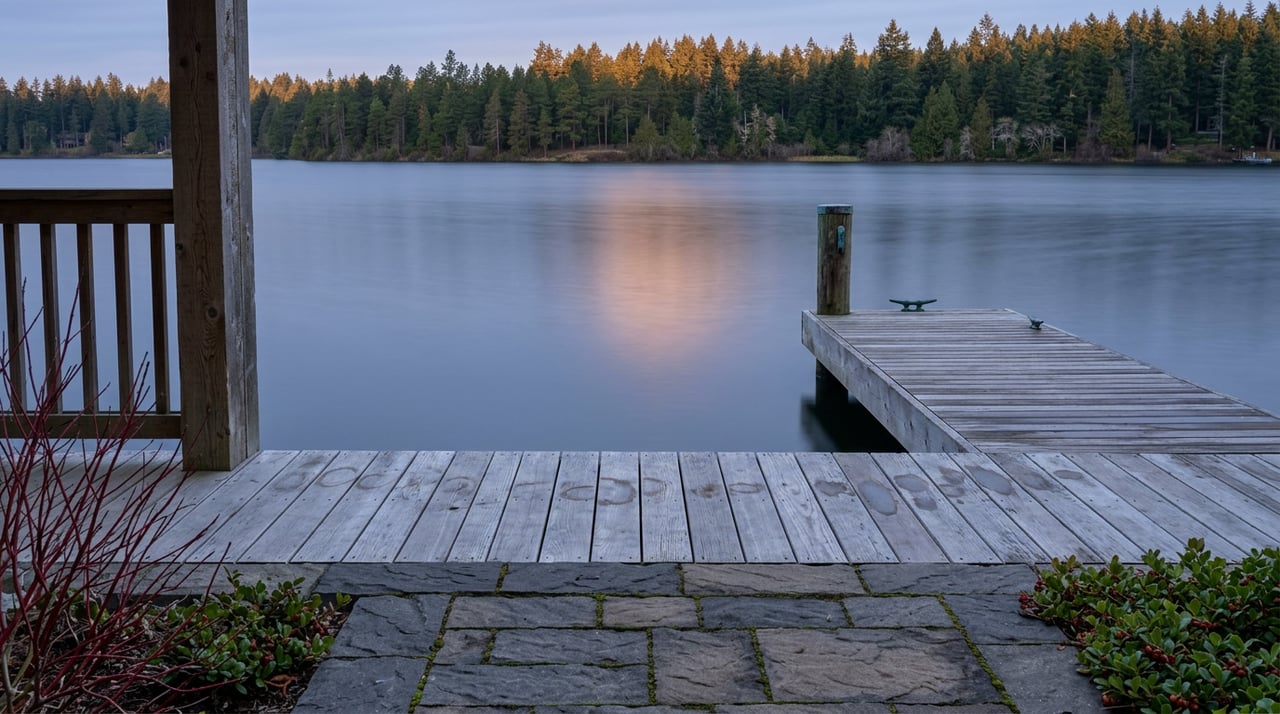
A buyer under contract on a lake home in McCall recently asked the natural question a week before closing: does the dock come with the house? The answer surprised him. On Payette Lake, a dock is not a fixture like a furnace or a built-in range. It sits on top of a state permit, and that permit belongs to a person, not a parcel. Selling the house does not automatically hand over the right to use the water in front of it.
That distinction is easy to miss because everything about a lakefront closing looks like ordinary real estate: a survey, a title search, an inspection, a walk-through. The dock paperwork lives in a separate universe, governed by the Idaho Department of Lands rather than the county recorder, and it has its own fee, its own form, and its own timeline. Buyers who assume it travels with the deed sometimes find out otherwise during the final week, when there is no time left to fix it.
Why the dock has its own government
Payette Lake is a navigable lake under Idaho law, which means the Idaho Department of Lands administers everything built on, in, or above it. IDL calls these structures encroachments, and the category is broad: docks, piers, mooring buoys, breakwaters, and shoreline stabilization work all qualify. Before any of them can be built, changed, or expanded, the owner needs an encroachment permit issued under the Idaho Lake Protection Act, Idaho Code Title 58, Chapter 13.
The part that catches people off guard is what happens when the property changes hands. IDL's own encroachment permit guidance is direct about it: if you are buying or selling lakefront property with an existing encroachment, you need to file a Request for Assignment form along with a $300 fee before the permit legally transfers to the new owner. Until that paperwork clears, the dock in the listing photos technically still belongs to someone else's permit.
What the paperwork looks like
| Item | Detail |
|---|---|
| Governing law | Idaho Lake Protection Act, Idaho Code Title 58, Chapter 13 |
| Local office | IDL Payette Lakes Area, 555 Deinhard Lane, McCall, ID 83638, (208) 634-7125 |
| Transfer document | Request for Assignment form, submitted with a $300 fee |
| Single-family dock size cap | 700 square feet, 10 feet wide, not counting a slip cutout |
| Setback from the neighboring property line | 10 feet from the riparian right line |
| Pre-1975 exception | Fee waived with documentation proving the dock predates 1975 and hasn't been modified |
The assignment itself is not complicated once someone knows to do it. It goes to IDL's Payette Lakes Area office in McCall rather than a state office in Boise, and it can typically move alongside the rest of a closing timeline if it's started early. The problem is almost never the process. It's that nobody flags it until title work is already underway and there's no slack left in the calendar.
The 1975 test
There's one wrinkle that rewards a seller who keeps good records. Encroachments built before 1975 and never modified since can be permitted without a fee, but only with what IDL calls substantive documentation: dated aerial photographs, the kind available through USGS's Earth Explorer archive, tax deeds, or other historical evidence showing the structure hasn't changed. A seller who can produce that proof hands the buyer a cleaner, cheaper transfer. A seller who can't may be looking at a dock that technically needs to go through a fuller review, because age alone isn't enough. It has to be provable age, with paper behind it.
This is the kind of detail that never shows up in a listing description, but it belongs on the pre-offer document request right next to the survey and the title commitment.
What a half-acre of shoreline just taught the market
The value of getting this right shows up in numbers the city itself is now paying. In 2024, McCall estimated it would spend between $15,000 and $30,000 to acquire, through eminent domain, a roughly 610-foot strip of undeveloped shoreline between Mile High Marina and Brown Park. The land is less than half an acre and isn't buildable. In May 2026, the city council approved the actual payment: $347,000, according to Valley Lookout. That's more than ten times the original estimate for land nobody can build a house on.
The city wants the strip so it can eventually pursue its own IDL encroachment permits for a non-motorized swimming area with a boardwalk and floating docks. Parks and Recreation Director Kurt Wolf told Valley Lookout the city couldn't get anything permitted this season and is aiming for late fall, once the lake level drops, with a target of having something in place for next season. Even the city, with eminent domain power on its side, is working on IDL's timeline, not its own.
The gap between the 2024 estimate and the 2026 price is the clearest evidence available that legal access to Payette Lake's shoreline has its own market, separate from the value of any house sitting on it. Idaho Fish and Game lists Payette Lake at 4,987.4 acres, and that number doesn't grow. Every dock permit attached to a private parcel is a claim on a fixed resource, which is exactly why the assignment process exists and exactly why it's worth taking seriously at closing rather than treating it as a formality.
The neighbor next door has a say
The assignment of an existing, unmodified dock is a relatively quiet transaction between the new owner and IDL. It gets louder if a buyer wants to replace, enlarge, or relocate the dock after closing. For those changes, IDL notifies the adjacent waterfront owners and gives them a chance to object. If an objection surfaces and the two sides can't work it out, IDL holds a formal administrative hearing before deciding.
That matters for anyone buying a lake home with plans to upgrade the dock in year two. The relationship with the property next door isn't just a courtesy. It's part of the permitting process, and it's worth understanding the current dock's history and any past friction with neighbors before assuming a renovation will sail through.
If your closing lands before your dock rights do
Boating season on Payette Lake doesn't wait for paperwork, and buyers who close in late spring sometimes find themselves without confirmed dock access for weeks while an assignment processes. One option in the meantime is May Marina, a private marina in downtown McCall that has operated on the lake since 1983. Slips are assigned from a waitlist based on a boat's length, beam, and draft, with priority given to sailboats, and openings depend on when existing slip holders sell or haul out their boats. It's not a substitute for owning dock rights outright, but it's a real fallback that local boaters have used for decades while their own paperwork catches up.
What this means at the negotiating table
For sellers, the fix is simple and worth doing before a home ever hits the market: gather the dock's permit number, any past IDL correspondence, and, if the structure predates 1975, whatever aerial photos or tax records can prove it. For buyers, the fix is to ask for that file during due diligence, not after mutual acceptance, and to build the $300 assignment fee and IDL's review time into the closing timeline the same way you would a well test or a septic inspection.
A few things worth confirming before removing contingencies:
- Whether the dock's IDL permit number matches what's on file with the Payette Lakes Area office
- Whether the structure has been modified since it was built, and if so, when
- Whether the seller has documentation to support a pre-1975 claim, if one applies
- Whether any part of the dock sits within 10 feet of a neighboring property's riparian line
Quick answers for buyers and sellers
Does the dock permit transfer automatically when the house sells? No. IDL requires a separate Request for Assignment form and a $300 fee before the permit moves to the new owner's name.
What if the dock predates 1975 but the paperwork proving it is missing? Without documentation like aerial photos or tax deeds, IDL may not treat it as automatically grandfathered, which can mean a fuller review rather than a fee waiver.
Can a new owner just replace an old dock without asking anyone? Not quietly. New construction or modification triggers notice to adjacent waterfront owners, and an unresolved objection can lead to a formal hearing.
Payette Lake's shoreline isn't getting any longer, and the paperwork attached to it is one of the few parts of a lake purchase that has nothing to do with square footage or finishes. Getting it right before closing, instead of during it, is the difference between owning a house with a dock and owning a house that's still waiting on one.
If you're buying or selling on Payette Lake and want a closing timeline that accounts for the permit work most listings leave out, the team at Beckman Hurley has handled it before. Request a Concierge Consultation and we'll walk through what your specific dock history looks like before it becomes a surprise.